


TL;DR:
- Modern golf equipment uses advanced multi-material designs to optimize energy transfer, forgiveness, and feel within regulatory standards. These innovations place materials strategically in high-stress zones like the clubface, shaft, and crown to enhance performance without breaching rules. Proper fitting and understanding of material placement are essential for maximizing the benefits of these technological enhancements.
Most golfers think about grip, stance, and swing tempo when they want more distance. Very few think about what their club face is actually made of. That’s a mistake. The difference between a driver face built from a single piece of titanium and one engineered from multi-material laminates isn’t cosmetic. It affects ball speed, forgiveness, spin stability, and even how the club feels at impact. Advanced materials in golf equipment have moved far beyond simple metallurgy, and understanding how they work gives you a real edge when making gear decisions.
Table of Contents
- Where advanced materials matter most in modern golf
- Layered design: Why multi-material faces outperform ‘pure’ metals
- How advanced materials boost forgiveness, distance, and control
- Golf club rules: Why ‘advanced’ designs always stay legal
- Common pitfalls and pro tips for choosing advanced gear
- The reality: What advanced materials actually deliver (and where hype ends)
- Explore innovative golf accessories to complement your gear
- Frequently asked questions
Key Takeaways
| Point | Details |
|---|---|
| Multi-material advantage | Advanced composite builds combine each material’s strengths to boost both speed and forgiveness. |
| Engineering matters most up front | Modern club faces use layered design for durability and energy transfer where it counts most. |
| Fit beats buzzwords | Fitting clubs and shafts to your swing brings more benefit than buying the latest material by itself. |
| Conformance keeps it fair | All advanced-material clubs must pass strict USGA and R&A rules before you can play them. |
Where advanced materials matter most in modern golf
Now let’s zero in on exactly where these new materials make a measurable difference on the course.
Not every part of a golf club benefits from advanced material science equally. The areas where stress concentrations are highest and energy transfer is most critical are where manufacturers invest the most engineering effort. Driver and fairway wood faces are the clearest example. These components experience enormous impact forces in fractions of a millisecond, and every design decision made at the material level directly affects how much energy transfers from club to ball.
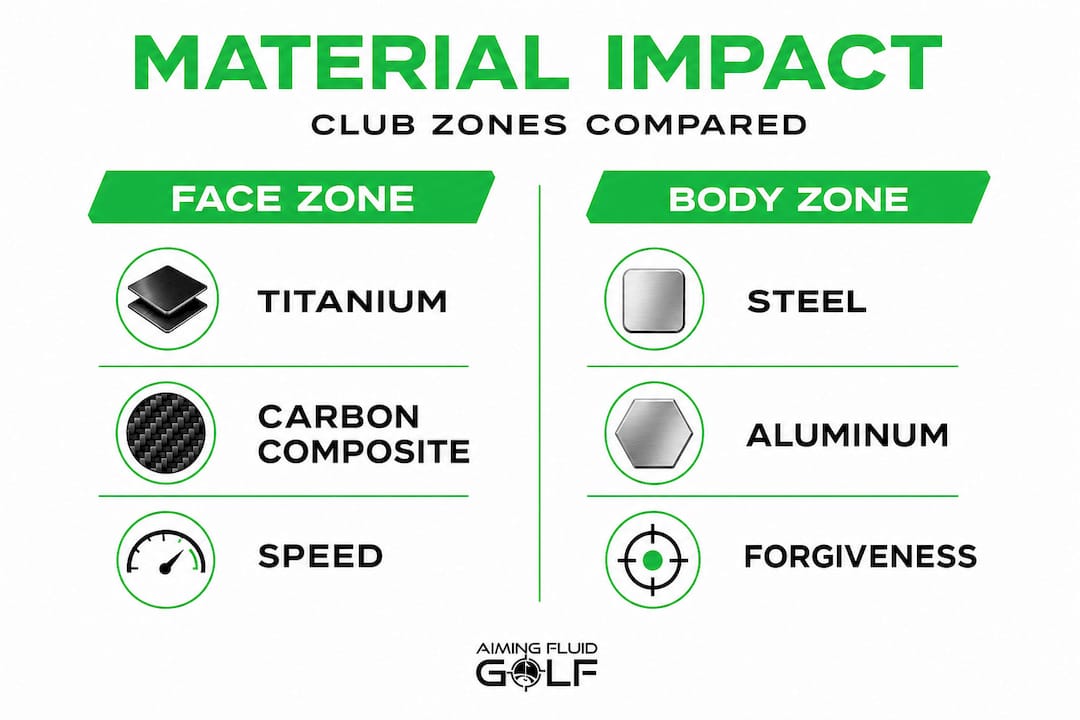
The golf equipment science behind this comes down to three primary zones: the face, the body or crown structure, and the shaft. Each zone has different mechanical demands, and each benefits from a different class of materials.
Where advanced materials appear in modern clubs:
| Club Zone | Primary Materials | Key Performance Effect |
|---|---|---|
| Driver face | Titanium alloy, carbon composite | Ball speed, forgiveness, energy return |
| Driver crown/sole | Carbon fiber panels | Weight savings, low CG placement |
| Shaft | Carbon/graphite composite layups | Stiffness, torque, vibration control |
| Fairway wood face | High-strength steel, titanium | Speed consistency across face |
| Wedge face | Softer steel alloys | Spin, feel, groove retention |
| Putter face | Aluminum inserts, polymer | Feel, sound, roll consistency |
The Callaway Tri-Force Face is a precise example of how far driver face engineering has come. It combines titanium at the front, a carbon fiber backing layer, and a polymer mesh between the two. One face. Three distinct materials. Each chosen for a specific mechanical role.
For shafts, the engineering story is equally sophisticated. Breakthrough Golf Technology exemplifies how manufacturers use data-driven composite layups to control exactly how a shaft bends, twists, and releases through the swing. Different fiber orientations, fiber densities, and resin systems all interact to define the shaft’s stiffness profile and torque range.
Putters and wedges sit at the other end of this spectrum. Feel and control take priority over raw energy transfer, so the material choices lean toward softer metals and polymer inserts rather than high-performance composites. This doesn’t mean materials don’t matter in those clubs. It means the target performance properties are different.
Pro Tip: If you’re shopping for a new driver, look past marketing labels and ask specifically which zones of the club use composite materials versus metal alloys. That tells you far more about the design intent than a brand name alone.
Layered design: Why multi-material faces outperform ‘pure’ metals
After identifying where these materials matter, let’s break down how manufacturers actually blend them for next-level performance.
A single-material driver face is essentially a design compromise. A pure titanium face, for example, must be thick enough to survive thousands of impacts without cracking, but thicker means heavier and less flexible. A pure carbon composite face avoids the weight issue, but carbon behaves differently under compression than tension, creating its own durability risks. The engineering insight behind multi-material faces is that no single material does every job best.
“Carbon and its composite architecture are strong in tension, where fibers are being stretched, but can be weaker in compression. Multi-material sandwich designs use each material where it performs best.”
Here is how the layered logic works in practice:
- Titanium front layer: Positioned at the primary impact zone. Titanium handles the compressive stress of ball contact without deforming or cracking. It’s the first material the ball sees, and it needs to be tough under repeated high-force loading.
- Carbon fiber backing: Sits behind the titanium. Carbon fiber is exceptionally strong in tension and very light. Placed in the rear of the face sandwich, it absorbs and distributes energy away from the impact zone, reducing stress concentrations.
- Polymer mesh interlayer: Bonds the titanium and carbon together. This layer manages the mechanical mismatch between two very different materials and helps transfer load between them without delamination. It also contributes to sound and feel at impact.
The result is a face structure where each layer does what it’s mechanically best at. Looking at the MOI vs POI in drivers discussion, it becomes clear that material placement directly influences how a driver distributes energy across off-center strikes, which is the core of forgiveness engineering.
Single-material vs. multi-material face comparison:
| Performance Factor | Single-material face | Multi-material face |
|---|---|---|
| Weight efficiency | Lower | Higher |
| Face thickness | Constrained by durability | Can be thinner in key areas |
| Sweet spot size | Standard | Expanded |
| Energy return | Good | Optimized by zone |
| Durability in impact zone | High | High (titanium retained) |
| Spin and launch tuning | Limited | Greater range of control |
The durability advantage of retaining titanium in the highest-stress region is a deliberate engineering choice. Manufacturers don’t remove titanium from the strike face because carbon alone cannot reliably handle that level of compressive loading over thousands of rounds.
How advanced materials boost forgiveness, distance, and control
Understanding the build is just one piece. Let’s see what these choices actually mean for your game.
The practical performance impact of multi-material faces comes down to three measurable outputs: ball speed, forgiveness, and spin stability. Each is connected to specific material decisions.
Ball speed increases when the face can flex more at impact, then spring back faster, transferring more energy to the ball. Thinner faces flex more. The Callaway Tri-Force titanium front layer was drawn 14% thinner versus the previous face design, and 25% thinner on the Max D variant. That’s a significant reduction in mass at the impact zone, directly enabling more face flex and higher ball speed without sacrificing structural integrity because the carbon backing is doing its job.

Forgiveness is about maintaining acceptable ball speed and launch conditions even on off-center strikes. Advanced face composites expand the effective working area of the face by engineering the flex pattern across a wider surface. The polymer interlayer plays a specific role here by stabilizing launch angle and spin rate across different impact locations.
Spin control is the most nuanced benefit. Golfers who struggle with excessive spin lose significant distance even at adequate swing speeds. The material system in a multi-layer face interacts with the ball differently at various impact points, and manufacturers can tune the face geometry and material properties together to reduce unwanted spin variation.
Key benefits, summarized:
- Thinner titanium front layers allow greater face flex and higher COR (coefficient of restitution), the measure of energy return from the face
- Carbon fiber backing reduces face weight, allowing engineers to redistribute mass for lower spin and better launch conditions
- Polymer interlayers stabilize ball speed and spin across the full face, not just the geometric center
- Overall weight savings from composite crowns and faces allow heavier sole weights for better MOI
Your golf ball compression interacts directly with how your driver face performs. A mismatched pairing between ball construction and driver face design costs you more yards than most golfers realize. Similarly, players in the mid-speed range benefit from specific ball constructions, as detailed in this best golf balls for mid swing speed breakdown.
Pro Tip: Don’t assume the biggest face equals the most forgiveness. The material engineering of the face matters as much as its physical size. Ask your fitter to show you ball speed data across the face, not just at center contact.
Golf club rules: Why ‘advanced’ designs always stay legal
Before believing the hype, it’s vital to know why you can’t simply buy a “super club” that breaks all the rules.
Every material innovation you read about in golf marketing exists within a tightly controlled regulatory framework. The USGA and R&A jointly define the equipment standards that all manufacturers must satisfy before selling clubs for use in sanctioned play. This framework covers face thickness, spring-like effect (measured as COR), clubhead volume, shaft length, and more.
“Even when manufacturers add novel materials, the club and ball must still meet governing equipment rules. The ‘advanced material’ advantage comes from optimizing within conformity.pdf) constraints.”
Here is the process a new material must pass before it reaches store shelves:
- Design and specification: Manufacturer defines the material system, geometry, and intended performance targets.
- Internal prototype testing: Performance is measured against USGA and R&A standards during development.
- Submission for conformance review: The club design and material specifications are formally submitted to governing bodies.
- Physical testing: Sample clubs are tested in certified facilities for COR, face thickness, and other regulated properties.
- Listing approval: Only after passing all tests does the design receive approval for legal play.
- Market release: The approved design goes to production and retail.
This process means that no manufacturer can sell a club that delivers illegal performance, regardless of how advanced the materials are. The innovation space is defined by the rules. Companies compete to optimize every inch of performance within that boundary. That’s why material science matters so much. It’s one of the few levers that can push performance forward without triggering a rule violation.
Common pitfalls and pro tips for choosing advanced gear
With technology always evolving, here’s what to look out for and how to make smart gear choices.
Advanced materials create genuine performance benefits, but they also generate significant marketing noise. Several common mistakes cost golfers both money and on-course results.
Top mistakes when selecting advanced-material clubs:
- Buying based on material name alone: Carbon fiber and titanium are words, not guarantees. The architecture and placement of these materials determines their actual effect.
- Ignoring shaft fitting: The carbon/graphite composite layups in modern shafts offer enormous variation in stiffness, torque, and kick-point. Choosing a shaft by flex label alone ignores the majority of what makes that shaft perform for a specific swing.
- Overlooking strike pattern: An advanced multi-material face delivers its full benefit only if your strike pattern is consistent enough to use the optimized zone. Fitting data showing your actual strike location should guide your decision.
- Skipping durability research: Some carbon-composite face designs have shorter durability windows than titanium counterparts. The compression-related concerns with pure carbon faces are real, which is precisely why well-engineered designs retain titanium at the highest-stress areas.
- Overlooking the full equipment system: Your tee height, ball, and even your wooden golf tees affect how your driver performs. Understanding golf tee benefits and using consistent tee heights gives the driver face a repeatable contact point, which is where all that material engineering actually pays off.
Pro Tip: Request a data-driven shaft fitting session from a certified fitter before investing in a premium shaft upgrade. Modern fitting launch monitors measure not just ball speed and spin, but also how the shaft’s dynamic behavior matches your transition tempo and load pattern. That match is where the gains are.
The reality: What advanced materials actually deliver (and where hype ends)
Here’s an uncomfortable truth that most equipment reviews won’t say plainly: for the majority of amateur golfers, a proper fitting delivers more measurable improvement than simply upgrading to the latest multi-material driver. That’s not a knock on the engineering. It’s an acknowledgment of how performance improvement actually works.
Advanced materials genuinely do what manufacturers claim, within the constraints described above. Thinner faces do produce higher ball speeds. Carbon crowns do shift weight for better launch conditions. These are real, measurable, and documented effects. The problem is that most golfers never experience the full benefit because their delivery pattern and swing mechanics aren’t yet consistent enough to exploit the full face working area.
The premium golf materials story is also one of diminishing returns. The jump from a 1990s cast steel driver to a modern multi-material driver is enormous. The jump from last year’s multi-material driver to this year’s version is far smaller. Marketing amplifies the latter while underplaying the former. Understanding this dynamic helps you make rational equipment decisions rather than chasing incremental gains at premium prices.
The most sophisticated golfers treat material science as one variable in a larger system. Fit, ball selection, tee consistency, and strike pattern all interact. A well-fit club made with thoughtful materials, used by a golfer who understands their own swing, will always outperform a technologically superior club bought on marketing alone.
Explore innovative golf accessories to complement your gear
You’ve spent real attention understanding what goes into advanced golf equipment. The next step is making sure everything around that gear is equally dialed in.

At Aiming Fluid Golf, we design accessories that complement high-performance equipment with the same level of intentionality. Our best golf accessories selection is built around practical solutions, not gimmicks. Our magnetic golf towels attach and detach instantly, keeping your face and grooves clean without breaking your focus between shots. Our DON’T SUCK™ golf tees are precision-engineered to deliver consistent tee height every round, giving your advanced driver face the repeatable setup it was designed for. Smart gear, well designed, makes the difference on every hole.
Frequently asked questions
Do advanced materials really make a difference for amateur golfers?
Yes, modern materials can provide extra forgiveness and distance, but correct club fitting remains more important for most amateurs because strike quality determines how much of that engineered benefit you actually use.
What’s the main downside of carbon composite in club faces?
Carbon composites can be less durable under extreme compressive impact loads, which is why well-engineered drivers retain titanium at the primary strike zone rather than going full composite.
Are there any equipment rules for using advanced materials in golf clubs?
Yes, all innovative equipment submissions.pdf) are tested by the USGA and R&A for rule conformance before any club reaches the retail market.
How do I know if an advanced-material shaft is right for my swing?
Get your shaft professionally fit using launch monitor data that captures your swing speed, tempo, and transition pattern, since composite shaft properties vary widely and only a fitting session reveals the right match.
Recommended
- 7 advantages of premium golf materials for top performance – Aiming Fluid Golf
- Smart design in golf accessories for efficient play in 2026 – Aiming Fluid Golf
- Hybrid Golf Tees Explained: Boost Your Game with Innovation – Aiming Fluid Golf
- Why robust golf tools matter: improve your game’s efficiency – Aiming Fluid Golf


